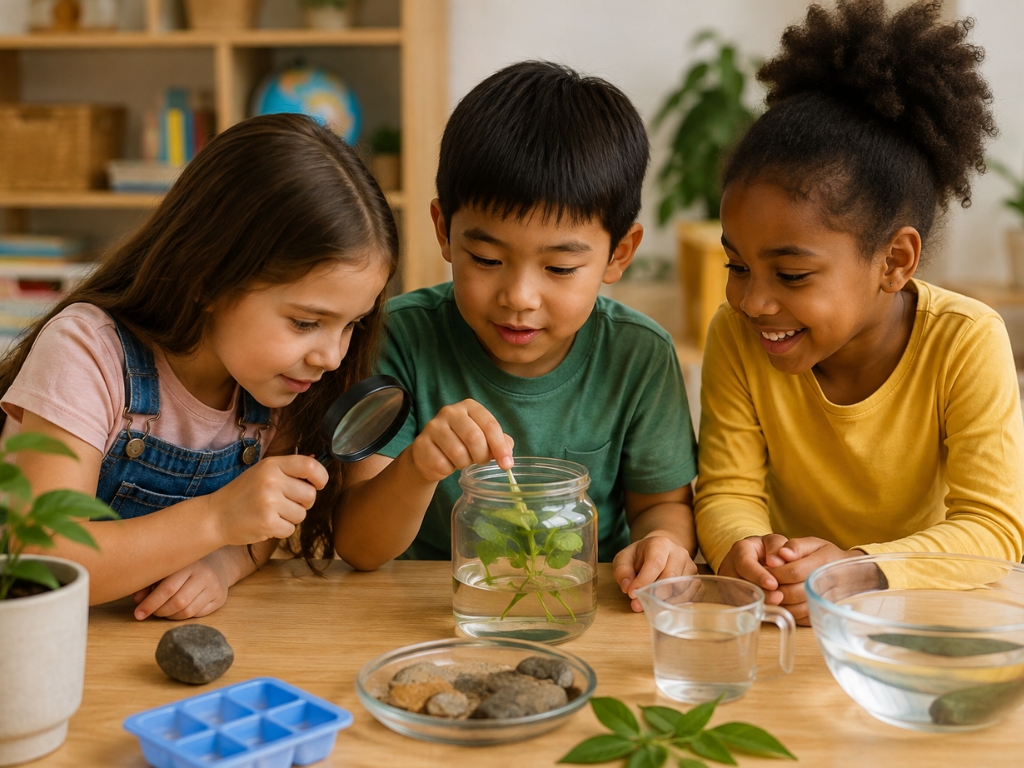
Children are natural scientists. They ask questions, investigate unfamiliar objects, experiment with different approaches, and eagerly watch what happens next.
While digital resources can have a place in education, kindergarten science activities do not need screens or complicated technology to make learning exciting.
In fact, ordinary materials such as water, ice, seeds, magnets, and paper can introduce children to fascinating scientific concepts through firsthand exploration.
Why Hands-On Science Matters in Kindergarten
At the kindergarten level, science is less about memorizing terminology and more about encouraging children to ask questions, make predictions, observe changes, and describe what they discover. Hands-on activities give children opportunities to practice these skills by actively participating in the learning process.
Hands-on learning can also provide a valuable alternative to screen-based activities. A systematic review and meta-analysis published in JAMA Pediatrics examined 95 samples involving 89,163 children and found that only 35.6% of children ages two to five met the guideline of one hour or less of daily screen time.
Screen-free activities can help create a more balanced routine while giving young children meaningful opportunities to explore how the world around them works.
What Are 10 Easy Science Experiments for Kids?
Easy science experiments for kids use familiar, age-appropriate materials to demonstrate concepts children can see, touch, and investigate. Here are 10 science activities for kindergarten that require no electronic devices.
1. Sink or Float?
Fill a clear bowl or container with water and gather several waterproof objects, such as a plastic toy, spoon, rock, cork, or bottle cap. Before placing each object in the water, ask children to predict whether it will sink or float. Test each item one at a time and compare the results.
This activity introduces children to buoyancy and the properties of materials. Rather than assuming that all heavy objects sink or all small objects float, children begin to see that an object’s behavior in water depends on multiple factors. Most importantly, they practice making a hypothesis and testing it through observation.
2. Grow a Seed
Place a damp paper towel inside a clear plastic bag or cup and position a bean or another fast-germinating seed where it can easily be seen. Keep the paper towel moist and have children observe the seed each day.
Watching the seed change provides a simple introduction to germination and plant life cycles. Children can see roots emerge before a shoot begins growing upward. Drawing or describing the changes each day also teaches them that scientific observations can be recorded and compared over time.
3. Go on a Magnet Hunt
Give children a child-safe magnet and gather objects made from different materials, such as paper, plastic, wood, aluminum foil, and steel. Have them predict which objects will be attracted to the magnet before testing each one.
The experiment introduces magnetism and material properties. Children discover that magnets attract certain materials but not everything made of metal. They also learn to sort objects according to observable results and look for patterns in their findings.
4. Mix New Colors
Fill clear cups with water and add a few drops of washable food coloring. Start with primary colors such as red, yellow, and blue. Ask children to predict what will happen when two colors are combined before pouring them together.
Color mixing demonstrates how combining substances can produce an observable change. Children learn about primary and secondary colors while practicing prediction and cause-and-effect thinking. They can continue experimenting by changing the amount of each color and comparing the results.
5. Race Melting Ice Cubes
Place equal-sized ice cubes in different conditions, for example, one in sunlight, one in shade, one in warm water, and another at room temperature. Ask children which cube they think will melt first and periodically check the results.
This activity introduces temperature and changes in states of matter. Children observe solid ice becoming liquid water and discover that environmental conditions affect how quickly this happens. Comparing melting times also encourages them to think about variables and what makes a test fair.
6. Make Water “Walk”
Place two cups of colored water on either side of an empty cup. Fold paper towels into strips and position one end in the colored water and the other in the empty cup. Leave the setup in place and watch as water gradually travels along the paper towel.
The experiment demonstrates capillary action, the movement of water through small spaces. Children can observe something that initially seems surprising, like water moving upward before traveling into another cup. It encourages questions about how water moves and how absorbent materials interact with liquids.
7. Discover What Dissolves
Fill several clear cups with the same amount of water. Provide safe substances such as salt, sugar, sand, and flour. Ask children to predict what will happen when each substance is added and stirred into the water.
This experiment introduces solubility and solutions. Children learn that some substances appear to disappear into water while others remain visible or settle at the bottom. They can compare the results and begin understanding that different materials behave differently even under the same conditions.
8. Investigate Shadows
Choose an object and place it outside in a sunny location. Observe or trace its shadow in the morning, then return to the same spot later in the day and compare its position and size.
Shadow investigations introduce children to light and the apparent movement of the Sun across the sky. They learn that a shadow forms when an object blocks light and that shadows can change throughout the day. Asking children to predict where the shadow will appear later adds another layer of scientific thinking.
9. Build a Ramp
Prop a piece of cardboard or another flat surface against a stack of books or blocks. Roll a toy car or ball down the ramp and observe how far it travels. Then raise or lower the ramp and repeat the test.
This activity explores motion, gravity, and cause and effect. Children can investigate how changing the ramp’s height affects an object’s movement. It also introduces the idea of changing one variable and observing how that change influences the outcome.
10. Test Water Absorption
Gather materials such as a sponge, cotton ball, paper towel, fabric, and plastic. Ask children to predict which will absorb water and which will not. Add the same small amount of water to each material and compare what happens.
The experiment explores absorption and material properties. Children discover that materials interact with water differently and can classify them as absorbent or nonabsorbent. They can take the investigation further by testing which absorbent material holds the most water, encouraging measurement, comparison, and evidence-based conclusions.
Turn Experiments Into Science Lessons
The best kindergarten science activities encourage children to think rather than simply watch. Adults can support the process by asking questions such as, “What do you think will happen?” “What did you notice?” and “What could we change next time?”
There is no need to rush in with the correct answer. A prediction that turns out to be wrong creates an opportunity to observe, reconsider, and try again.
Science can also become part of everyday routines. Children can observe insects outside, sort leaves, compare rocks, watch puddles disappear after rain, or investigate which clothes dry fastest. These experiences show that science is not confined to a classroom experiment. It is happening everywhere.
Keep Curiosity Growing Beyond the Screen
Hands-on science helps kindergarteners explore concepts like plants, water, motion, and magnetism while building curiosity through observation and experimentation.
At Quality Interactive Montessori Preschool, children have opportunities to learn through meaningful, hands-on experiences that encourage discovery and independent thinking. Contact Quality Interactive Preschool & Montessori today to learn more about its approach to early childhood education.