Many parents assume that more toys mean more learning opportunities, but too many choices can actually make it harder for young children to focus and engage deeply.
In Montessori education, the emphasis is on offering fewer, carefully chosen materials that support meaningful exploration rather than constant stimulation.
Supporting this approach, a study published in Infant Behavior and Development found that toddlers given only four toys played with them longer and more creatively than those given sixteen toys.
That’s why a preschool Montessori classroom uses a carefully prepared environment with a limited selection of purposeful materials that encourage concentration, independence, and hands-on learning.
Why Doesn’t a Preschool Montessori Classroom Have Shelves Full of Toys?
At first glance, a preschool Montessori classroom may seem surprisingly simple. However, every material is intentionally selected to support a child’s development rather than simply provide entertainment.
Every Material Has a Learning Purpose
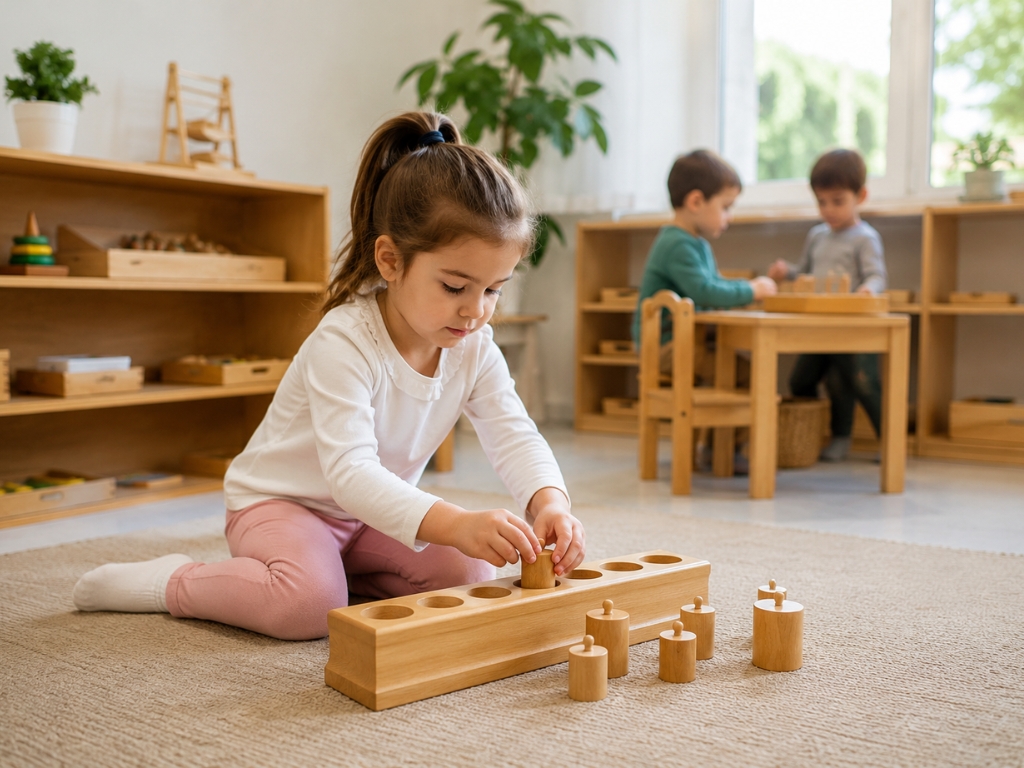
In a Montessori classroom, each material is designed to isolate and teach a specific concept or skill, such as sequencing, quantity, fine motor control, or sensory discrimination. Rather than providing general entertainment, the materials encourage repeated practice until children develop competence through hands-on exploration.
Less Clutter Supports Better Concentration
Limiting the number of available materials reduces visual and cognitive distractions, making it easier for children to sustain attention on a single activity. This organised environment supports longer periods of focused work and helps children develop self-regulation and task persistence over time.
Quality Matters More Than Quantity
Montessori classrooms prioritise open-ended, developmentally appropriate materials that can be used in multiple ways as children’s abilities progress. Repeated interaction with familiar materials reinforces learning, promotes problem-solving, and allows children to build increasingly complex skills through exploration rather than constant exposure to new toys.
How Fewer Toys Encourage Deeper Learning
Having fewer choices does not limit learning. In many cases, it encourages children to explore more thoroughly and remain engaged for longer periods. Rather than moving quickly from one toy to another, children are more likely to investigate materials, repeat activities, and work through challenges independently.
- Promotes longer attention spans. With fewer distractions competing for their attention, children are more likely to remain focused on a single activity and complete it before choosing another.
- Encourages repetition that strengthens learning. Repeating the same activity helps children refine motor skills, reinforce new concepts, and improve accuracy through practice.
- Supports deeper problem-solving. Children are more likely to experiment with different strategies and work through challenges independently instead of abandoning an activity for another toy.
- Develops executive functioning skills. Making thoughtful choices, following multi-step activities, and completing tasks help strengthen planning, self-control, and working memory.
- Encourages creative exploration. Open-ended materials can be used in multiple ways, allowing children to test ideas, adapt their approach, and discover new possibilities through play.
- Reduces cognitive overload. Limiting the number of available materials decreases the mental effort required to choose an activity, making it easier for children to focus their attention on learning.
- Builds confidence through mastery. Spending more time with a material allows children to experience measurable progress, increasing self-confidence as they successfully develop new skills.
- Supports independent learning. A simplified environment encourages children to make decisions, manage materials responsibly, and engage in self-directed learning with minimal adult intervention.
The Role of Toy Rotation in Montessori Learning
Toy rotation is the practice of making only a small selection of toys or learning materials available at one time while storing the rest out of sight. Instead of giving children access to everything they own, parents or teachers periodically replace the available materials with different ones based on the child’s interests, developmental stage, or learning progress.
In Montessori learning, the same principle is applied to educational materials. Teachers carefully select which activities are placed on open shelves, ensuring each one aligns with children’s current developmental needs and learning objectives.
As children master a material or demonstrate readiness for a more advanced concept, that activity is rotated out and replaced with another that builds on previously acquired skills.
This intentional approach keeps the classroom organised, reduces visual distractions, and encourages children to spend more time exploring each material. Rather than moving quickly between numerous options, children are able to engage in focused, purposeful work that supports concentration, independence, and skill development.
Why Children Become More Independent With Fewer Choices
Developing independence is a central goal of Montessori education, and the classroom environment is intentionally designed to support it. Rather than relying on frequent adult direction, children are encouraged to manage their own work, make appropriate choices, and take responsibility for their learning throughout the day.
With a carefully selected set of materials available, children learn to plan their activities, retrieve what they need, and return each item to its proper place when finished. These daily routines strengthen executive functioning skills such as organisation, self-management, and decision-making.
Children also become more aware of their role in maintaining the classroom community. By caring for shared materials and respecting established routines, they develop responsibility, accountability, and practical life skills that extend beyond the classroom into everyday situations.
Discover the Benefits of a Purposeful Learning Environment
A thoughtfully prepared learning environment can make a meaningful difference in how children learn, grow, and develop confidence. At Quality Interactive Montessori Preschool, our classrooms are intentionally designed with carefully selected Montessori materials that encourage concentration, independence, creativity, and hands-on discovery at every stage of early learning.
If you’re looking for a preschool that values purposeful learning over unnecessary distractions, we’d love to welcome your family. Contact us today to learn more about our programs or schedule a tour.