Parents naturally want to help when their child struggles, whether it’s with a puzzle, a jacket zipper, or a block tower. While well-intentioned, stepping in too quickly can limit opportunities for children to develop independence and problem-solving skills.
In a quality early preschool, teachers take a different approach by encouraging productive struggle, allowing children to work through manageable challenges before offering guidance. This balance of support and independence helps build confidence, resilience, and critical thinking skills that benefit children long after preschool.
What Is a Productive Struggle for Kids?
Productive struggle encourages children to work through age-appropriate challenges before receiving help from an adult. Rather than providing immediate answers, teachers and parents allow children time to think, experiment, make mistakes, and try different strategies while offering encouragement and guidance when needed.
The goal is not to make learning harder, but to give children opportunities to build confidence, independence, and problem-solving skills through their own efforts.
A productive struggle differs from frustration. The task should be challenging enough to require persistence but still achievable with minimal support.
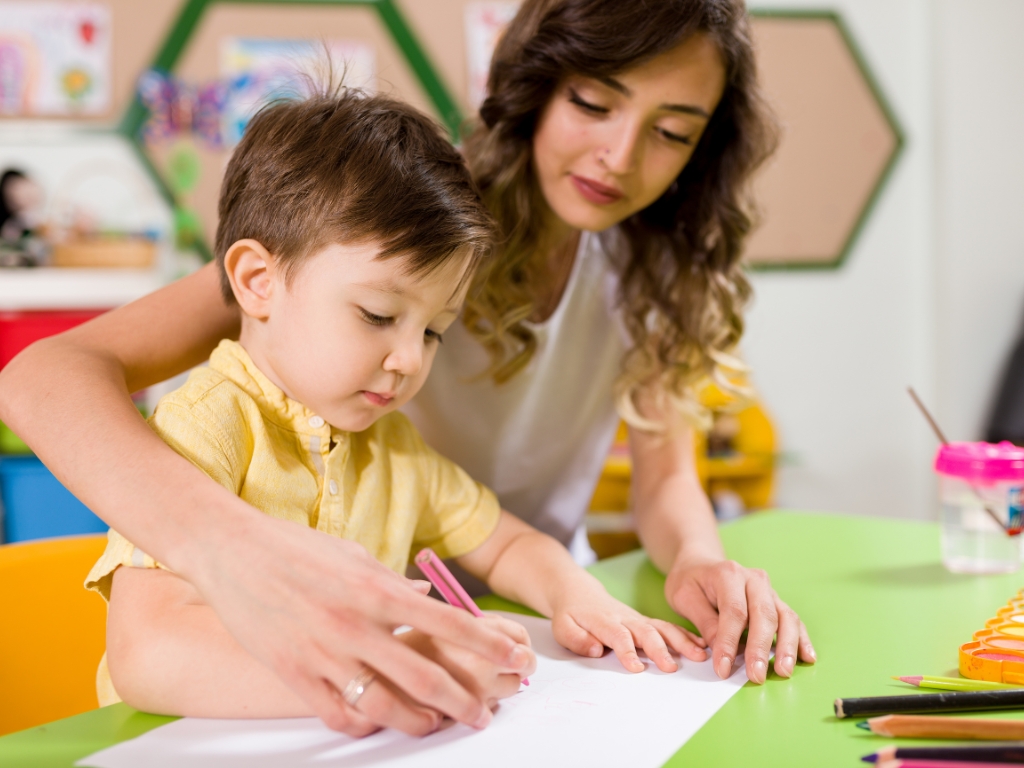
If a child becomes overwhelmed or discouraged, a teacher may step in with a question, hint, or demonstration instead of completing the task for them. This type of “scaffolding” keeps children engaged while allowing them to remain active participants in the learning process rather than passive observers.
Educational psychologist Lev Vygotsky’s concept of the Zone of Proximal Development (ZPD) suggests that children learn most effectively when working on tasks that are just beyond what they can accomplish independently but can complete with appropriate guidance from a more knowledgeable adult or peer.
Why Early Preschool Teachers Don’t Jump In Immediately
Rather than focusing only on the outcome, early preschool teachers value the learning that happens during the process. Working through small challenges helps children grow in ways that extend beyond the classroom.
1 | Children Develop Problem-Solving Skills
When teachers give children time to work through a challenge, they encourage them to think critically instead of relying on someone else for the answer. Children begin to observe what isn’t working, try different strategies, and learn through trial and error. Even simple classroom activities, such as completing a puzzle or figuring out how to stack blocks without them falling, require planning and decision-making.
More importantly, they learn that challenges can often be solved with patience and persistence, helping them become more confident when facing unfamiliar situations.
2 | Independence Grows Through Practice
Many everyday tasks that seem simple to adults are important learning opportunities for young children. Activities such as putting on a jacket, washing hands, cleaning up toys, or opening a lunch container allow children to practice doing things for themselves. While these tasks may take longer at first, repeated practice helps children become increasingly capable and self-reliant.
By resisting the urge to step in immediately, early preschool teachers encourage children to take ownership of their actions. As children experience success through their own efforts, they become more willing to tackle new responsibilities and develop the independence they’ll need as they progress through school.
3 | Confidence Comes From Personal Achievement
Children feel proud when they accomplish something they once found difficult. Whether they finish a challenging puzzle, write their name for the first time, or solve a disagreement with a classmate, those achievements have a lasting impact because they were earned through their own effort.
When adults solve every problem, children may begin to doubt their own abilities or wait for someone else to take over. By allowing children to experience manageable challenges, teachers help them develop genuine self-confidence built on experience rather than praise alone.
4 | Executive Function Skills Become Stronger
Productive struggle also strengthens executive function skills or the mental processes that help children focus, remember instructions, control impulses, and adapt when things don’t go as planned. These skills develop rapidly during the preschool years and play an important role in both academic success and everyday life.
For example, when a child changes their approach after a block tower collapses or remembers the steps needed to complete a classroom activity, they are exercising these important cognitive skills. Giving children opportunities to think through challenges independently helps build a strong foundation for future learning.
5 | Children Learn That Mistakes Are Part of Learning
Mistakes are an inevitable part of childhood, and early preschool teachers intentionally create an environment where children feel safe making them. Instead of treating mistakes as failures, educators encourage children to view them as opportunities to learn, adjust, and try again.
Over time, children begin to understand that improvement comes through practice rather than perfection. Instead of giving up after one unsuccessful attempt, they become more willing to persist, experiment with new ideas, and celebrate progress.
How Teachers Know When to Step In
Knowing when to help is just as important as knowing how to help. In an early preschool, teachers don’t leave children to struggle indefinitely. Instead, they carefully observe each child’s progress, paying attention to whether the challenge is helping the child learn or becoming a source of discouragement. Their goal is to provide support at the right moment—not too early and not too late.
Teachers typically step in when:
- A child becomes overly frustrated and is close to giving up.
- The task is beyond the child’s developmental abilities and additional guidance is needed.
- The child stops trying and can no longer think of another approach.
- Safety becomes a concern, such as during physical play or when using classroom materials.
- A social conflict escalates beyond what children can resolve independently.
- A child has made a genuine effort but still needs support to move forward.
When intervention is needed, teachers avoid taking over the task whenever possible. Instead, they ask guiding questions, offer small hints, break the activity into manageable steps, or provide encouragement that helps children continue independently. This balanced approach allows children to overcome challenges while still developing confidence, resilience, and problem-solving skills.
How Parents Can Encourage Productive Struggle at Home
The benefits of productive struggle don’t have to end when the school day is over. By creating opportunities for children to solve age-appropriate challenges on their own, parents can reinforce the same skills being developed in an early preschool classroom. Small changes in everyday interactions can help children become more confident, independent, and resilient over time.
Here are a few ways to encourage productive struggle at home:
- Give children time to try first. Pause before stepping in so your child has an opportunity to think through the challenge independently.
- Ask guiding questions instead of giving answers. Questions like, “What else could you try?” or “What do you think will happen if…?” encourage problem-solving.
- Praise effort, not just results. Recognize persistence, creative thinking, and willingness to keep trying, even if the outcome isn’t perfect.
- Encourage independence during daily routines. Let children practice dressing themselves, cleaning up toys, pouring drinks, or helping with simple household tasks.
- Allow room for mistakes. Remind your child that mistakes are a normal part of learning and an opportunity to improve.
- Avoid rushing through everyday tasks. Build extra time into your routine so children can complete activities at their own pace without feeling pressured.
When parents and early preschool teachers use a similar approach, children receive consistent encouragement to tackle challenges, build confidence, and develop the independence they’ll carry into future learning experiences.
Help Your Child Grow Through Every Challenge
Every challenge is an opportunity for your child to grow. At Small Miracles Education, our early preschool program encourages independence, confidence, and resilience through hands-on learning and thoughtful teacher guidance that supports children every step of the way.
If you’re looking for an early preschool where your child can thrive academically, socially, and emotionally, contact Small Miracles Education today to learn more about our programs or schedule a tour.