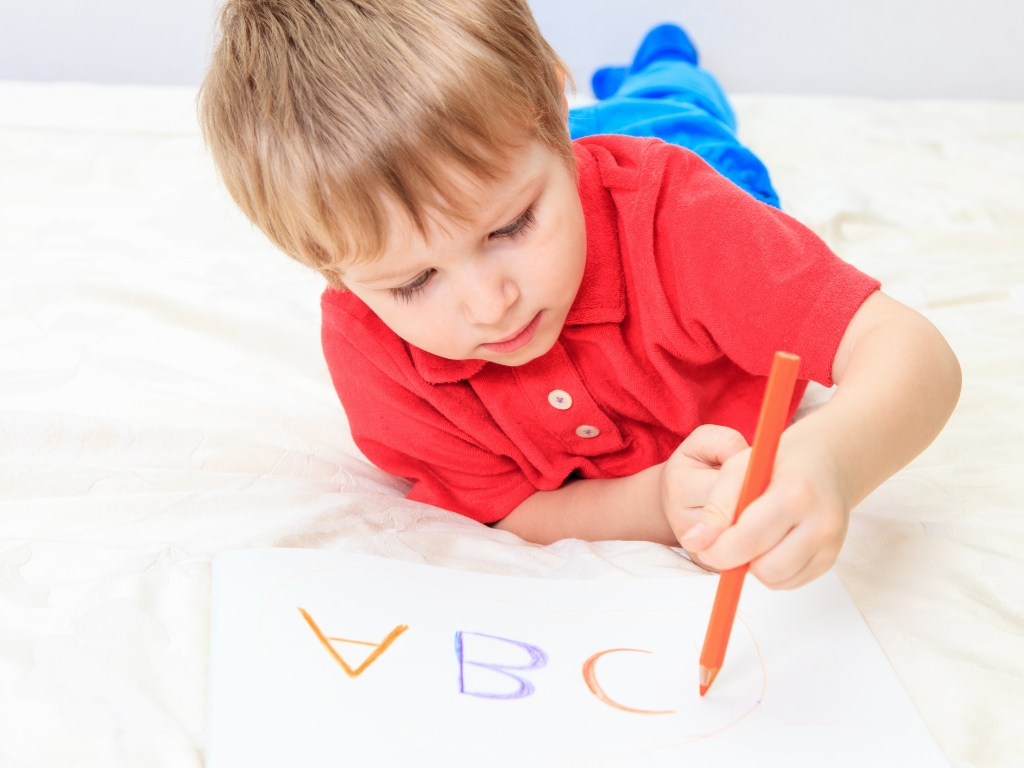
You’re sitting at the table while your child works on a short sentence. They finish, smile, and slide the paper toward you. Then you see it: a backward “b.” Maybe a flipped “s” or a “d” facing the wrong direction.
Your first reaction might be worry. Is this normal? Did we miss something? Is my child already behind in kindergarten writing?
These questions are common. Many parents quietly carry the same concern. Writing feels foundational. If something looks off this early, it can feel serious. But in most cases, letter reversal during kindergarten writing is a normal part of development, not a warning sign.
Why Letter Reversal Happens in Kindergarten Writing
To understand reversal, it helps to understand what writing actually requires at this age. Writing is not just copying shapes on paper. When your child writes a word, their brain is coordinating sound recognition, visual memory, spatial awareness, hand strength, pencil control, and idea generation all at once.
That is a heavy cognitive load for a five- or six-year-old.
Letters like b, d, p, and q are particularly confusing because they are mirror images. To an adult brain, orientation is automatic. To a developing brain, left and right are still being solidified. Many kindergarteners have not yet fully internalized directionality. Their brains are still organizing how symbols sit in space.
Reversals often happen because the child remembers the letter shape but hasn’t locked in its direction. In other words, they know the letter; they just don’t consistently know which way it faces. That distinction matters.
In kindergarten writing, mistakes often signal active learning. Your child is experimenting, retrieving information, and attempting independence. That effort is a positive sign.
Is Letter Reversal Normal?
Yes, in kindergarten, it usually is. Occasional reversals are developmentally expected through early elementary years. Most children outgrow them naturally as reading exposure increases and writing becomes more automatic.
What matters more than the mistake itself is the pattern over time. Is your child gradually improving? Do they sometimes write the letter correctly? Are reversals becoming less frequent? Progress, even if it is slow, is the key indicator of healthy development.
Letter reversal alone is not a reliable sign of dyslexia in kids. It becomes more concerning only when paired with persistent difficulty connecting sounds to letters, extreme avoidance of literacy tasks, or little improvement over time. Without those additional concerns, reversals are usually temporary.
What Should a Kindergartener Be Able to Write?
This is where expectations often become unrealistic. Social media and polished worksheets can make it seem like kindergarteners should be writing full, neatly spelled paragraphs. That is not developmentally accurate.
By the end of kindergarten, most children are working toward writing their first and last name, forming most uppercase and lowercase letters, writing simple phonetic words such as “cat” or “dog,” labeling drawings, and producing short sentences with support.
Spelling is typically phonetic at this stage. You might see “KT” for cat or “I LUV MOM.” That reflects sound awareness. It shows the child is listening to the sounds in a word and attempting to represent them in print. That skill is more important than correct spelling in early kindergarten writing.
If your child can hear sounds, attempt letters, and express simple ideas, their foundation is forming, even if the letters are not perfect.
When Should Parents Pay Closer Attention?
Monitoring growth is wise. Panic is not.
You may want to talk with a teacher if reversals continue consistently past age seven, if your child struggles significantly to connect letters with sounds, or if frustration becomes intense and persistent. It is the combination of signs, not a single backward letter, that signals deeper concern.
Ask yourself: Is my child showing growth month to month? Are they willing to try? Do they recognize letters in books even if they occasionally reverse them in writing?
Improvement over time matters more than momentary accuracy.
How to Support Kindergarten Writing at Home
Supporting kindergarten writing at home can feel overwhelming. You want to help. You want your child to improve. But you also don’t want writing time to turn into a battle.
If your goal is steady improvement without pressure, the strategies below will help you support your child in a way that builds skill and protects motivation at the same time.
- Resist the urge to correct every mistake immediately.
Your instinct to help is natural, but constant correction can make writing feel stressful. When children associate writing with pressure, they are more likely to avoid it. - Reinforce left-to-right direction through reading.
Read with your child every day and track the words with your finger. This simple habit strengthens directionality, which directly supports kindergarten writing development. - Build fine motor strength outside of writing time.
Activities like drawing, cutting with scissors, building with small blocks, and playing with clay strengthen the muscles needed for controlled letter formation. - Create purposeful reasons to write.
Writing feels more meaningful when it has a purpose. Invite your child to help write a grocery list, label a drawing, or write a short note to a family member. - Respond to mistakes with encouragement first.
When you notice a reversed letter, start by acknowledging effort. A response like, “I like how carefully you wrote that. Let’s look at how this letter usually faces,” supports learning without damaging confidence. - Protect confidence at all costs.
Confidence fuels practice. Practice fuels accuracy. Over time, accuracy reduces reversals naturally.
How Writing Is Supported at Small Miracles Education
At Small Miracles Education, kindergarten writing is treated as a developmental process, not a race toward perfection. Children build letter-sound connections, strengthen fine motor skills, and experiment with expressing ideas through guided activities.
Teachers observe patterns over time rather than reacting to isolated mistakes. Reversals are monitored, but they are understood within the larger picture of growth. Instruction adjusts to meet each child’s readiness level so skills build steadily and confidently.
What Parents Should Remember
A backward letter in kindergarten writing is usually a temporary phase, not a prediction of future struggle. It reflects a brain organizing new information and a child practicing a complex skill.
Writing at this age is about building foundations. With steady support, realistic expectations, and patient guidance, most children move past reversals naturally.
If you ever find yourself wondering whether your child’s writing development is on track, you don’t have to figure it out alone. At Small Miracles Education, families are supported with age-appropriate guidance that respects each child’s pace and learning style.