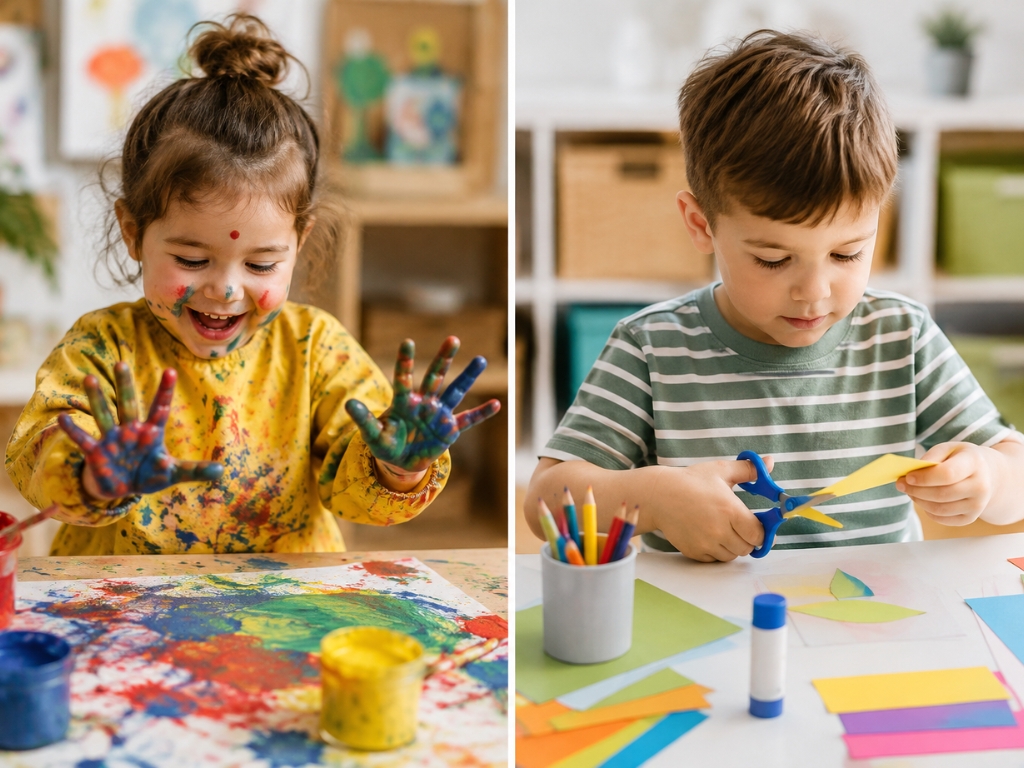
Paint on little hands, glue on the table, and scraps of paper scattered across the floor can make craft time look productive, but does more mess actually mean more learning?
Not necessarily. While messy preschool crafts can offer valuable opportunities for sensory exploration and experimentation, cleaner activities can build many of the same developmental skills.
The real question isn’t how much cleanup an activity requires. It’s how much children get to explore, think, create, and make decisions along the way.
What Makes Preschool Crafts Educational?
A craft doesn’t need to produce a picture-perfect result to be worthwhile. In fact, much of the learning happens during the creative process itself.
The National Association for the Education of Young Children (NAEYC) explains that process-focused art gives children opportunities to explore materials without having to reproduce a predetermined result. These experiences can support fine-motor development while encouraging problem-solving, planning, prediction, and creative thinking.
Effective preschool crafts can give children opportunities to practice:
- Fine-motor control
- Creativity and self-expression
- Planning and decision-making
- Problem-solving
- Communication
- Persistence
Both messy and mess-free activities can offer these benefits. They simply create different opportunities to practice them.
What Do Children Learn From Messy Preschool Crafts?
Finger paint, clay, playdough, watercolors, liquid glue, and other hands-on materials invite children to explore through touch and movement.
Imagine a preschooler trying to build a tall figure from clay. It keeps leaning over, so the child adds more clay to the bottom, reshapes it, or starts again. Without realizing it, the child is experimenting with weight, balance, shape, and structure.
Messy preschool crafts also let children investigate questions such as:
What happens when two paint colors mix?
How does clay change when squeezed or rolled?
Why does one material stick while another falls off?
Adults can encourage this exploration by resisting the urge to immediately correct problems. Questions such as “What else could you try?” give children space to develop their own solutions.
What Do Children Learn From Mess-Free Preschool Crafts?
Mess-free doesn’t mean learning-free. Drawing, cutting paper, creating sticker collages, threading beads, folding paper, and weaving can all require concentration and careful hand movements. These activities can strengthen hand-eye coordination, precision, sequencing, and independence.
They also have an important practical advantage: they’re easy to fit into everyday routines. A box containing paper, crayons, stickers, and child-safe scissors can become an independent activity without requiring a lengthy setup or cleanup.
Cleaner preschool crafts can also be highly creative. Give several children blank paper and the same collection of materials, and chances are they won’t produce identical creations.
Which Is Better for Fine-Motor Development?
Both messy and mess-free activities can exercise the small muscles children use for increasingly precise movements.
Messy activities may involve pinching clay, squeezing bottles, rolling dough, spreading glue, or controlling a paintbrush. Cleaner projects might involve peeling stickers, cutting along lines, threading beads, folding paper, or drawing.
Rather than choosing one over the other, variety can give children opportunities to practice different movements, grips, and levels of precision.
Process-Focused vs. Product-Focused Crafts
A more useful comparison may be process versus product, rather than messy versus clean.
In process-focused art, children decide what to make and how to use the materials. A cardboard tube might become a telescope, tower, tree, or something adults can’t immediately identify.
Product-focused activities typically involve following instructions toward a recognizable result. These projects can still help children practice skills such as sequencing, listening, and following directions.
The key is balance. If every craft requires children to copy an adult’s example exactly, there may be fewer opportunities for experimentation and independent thinking.
One simple question can help adults evaluate an activity: How many decisions does the child get to make?
Why There Is Room for Both
Messy crafts can be ideal when children have plenty of time and space to explore. Outdoor art sessions, sensory activities, and dedicated classroom craft periods are natural opportunities to bring out paint, clay, water, and other tactile materials.
Mess-free activities can work especially well during shorter activity periods, before meals, while traveling, or whenever cleanup time is limited.
Children also have different sensory preferences. Some happily plunge both hands into finger paint, while others prefer using a brush or keeping their hands clean. Offering alternatives allows children to participate without forcing an uncomfortable sensory experience.
How to Make Any Preschool Craft More Educational
Whether the table ends up spotless or covered in paint, adults can make preschool crafts more meaningful by giving children an active role.
Try providing several materials to choose from, asking open-ended questions, allowing mistakes, and encouraging children to explain their creations. Avoid fixing every problem immediately or showing a “perfect” example that children feel expected to copy.
These principles align with the broader importance of play in early development. The American Academy of Pediatrics reports that play supports areas including language, executive functioning, early mathematics, social development, and peer relationships.²
The Best Crafts Aren’t Defined by the Cleanup
So, which is better for learning: messy or mess-free?
Neither automatically wins.
Messy preschool crafts can provide rich opportunities to investigate textures, materials, and cause and effect. Mess-free projects can offer equally meaningful practice in creativity, fine-motor control, concentration, and independent decision-making.
A healthy mix gives children different ways to explore and create. Instead of asking, “How messy will this get?” consider a more useful question: “What will my child get to explore, decide, and discover?”
At Old Spanish Trail School, creative, hands-on activities give children opportunities to learn through exploration and self-expression. Contact Old Spanish Trail School today to learn more about its preschool programs and how engaging learning experiences can support your child’s development.