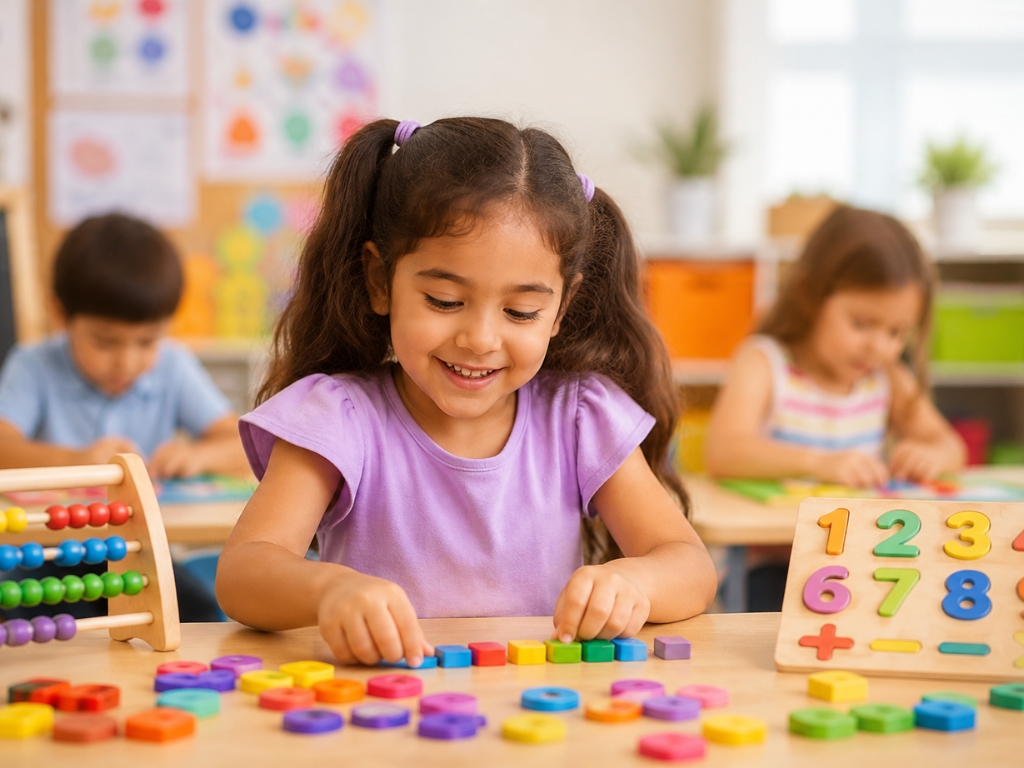
For young children, sitting down with a page of equations may not be the most exciting introduction to math. Fortunately, addition for kindergarten can happen almost anywhere. Building with blocks, rolling dice, telling stories, or even eating a snack can become an opportunity to explore how numbers work.
Research supports bringing play into early math learning. Researchers from the PEDAL Research Centre at the University of Cambridge conducted a systematic review of 39 guided-play studies, with 17 studies involving 3,893 children included in the meta-analysis.
The key is to make addition something children can see, touch, and experience. Here are seven simple ways to get started in addition for kindergarten.
What Is the Best Way to Teach Addition to Kindergarteners?
Start with real quantities children can physically combine. Before expecting a child to understand 3 + 2 = 5 on paper, let them put three objects next to two more and count the complete group.
This approach reflects kindergarten math standards, which describe addition as “putting together and adding to.” Children can represent problems with objects, fingers, drawings, sounds, movements, explanations, and eventually equations.
As children play, adults can encourage deeper thinking with questions such as, “How many are there altogether?” or “What happens if we add one more?”
1. Build Addition Towers With Blocks
Building blocks make quantities easy to see and manipulate. Ask a child to build a tower with three blocks and then add two more.
After counting all five blocks, connect the activity to 3 + 2 = 5.
For an extra challenge, ask the child to find different ways to make five. They might discover 1 + 4, 2 + 3, and other combinations while simply building towers.
2. Roll, Add, and Build With Dice
Dice can turn addition for kindergarten into a quick game. Roll two dice, count the dots on each, and combine the quantities using counters, blocks, or small toys.
For beginners, use dice with quantities from one to three. As children become more comfortable, introduce standard dice or encourage them to recognize one quantity and count on from there.
3. Play Addition Hopscotch
Turn the floor or sidewalk into a number line using chalk, tape, or numbered cards.
If the problem is 2 + 3, have the child start at two and make three jumps forward, landing on five. Change things up with bunny hops, giant steps, or frog jumps.
This activity connects numbers with physical movement, giving active learners another way to experience addition.
4. Tell Addition Stories With Toys
Favorite toys can make abstract numbers meaningful.
Try saying, “Two dinosaurs are at the pond. Three more dinosaurs arrive. How many are there now?” Let the child move the dinosaurs together and count the new group.
Once they understand the game, reverse the roles. Ask them to invent an addition story for you to solve. Creating a problem can reveal just as much about their understanding as answering one.
5. Practice Addition at Snack Time
Everyday routines offer plenty of opportunities for addition for kindergarten without creating another formal lesson.
Place two apple slices on a plate, add two more, and ask how many there are altogether. Crackers, fruit pieces, or other age-appropriate foods can work just as well.
Keep the conversation casual. The goal is to help children notice that math exists beyond worksheets and classrooms.
6. Discover Number Combinations With Dominoes
Dominoes conveniently separate two quantities while keeping them on the same piece. Have children count the dots on each side and then find the total.
A domino showing two dots and three dots becomes 2 + 3 = 5.
Compare several dominoes to show how different combinations can produce the same number. This kind of number exploration has a strong research foundation.
7. Go on an Addition Treasure Hunt
Hide safe objects around the home, classroom, or play area and give children a mission.
Ask them to find three blocks and bring them back. Then ask them to find two more. Put everything together and ask, “How many blocks do you have altogether?”
Treasure hunts naturally introduce useful words such as add, more, total, and combine while keeping children moving and engaged.
How Can Adults Make Addition Games More Educational?
The best addition games leave room for children to think, experiment, and explain their ideas. Adults can make playful math activities more meaningful by:
- Asking open-ended questions. Instead of immediately correcting an answer, ask, “How did you figure that out?” or “Can you show me another way?”
- Using hands-on objects. Blocks, counters, toys, or other familiar items can help children see what happens when two quantities are combined.
- Connecting different representations. After solving a problem with blocks, encourage children to draw what happened and then connect the drawing to an equation.
- Letting children explain their thinking. Give them time to describe how they reached an answer rather than focusing only on whether the answer is correct.
- Adjusting the difficulty. Start with small quantities and introduce more challenging problems as children become comfortable with the concept.
- Keeping activities short and enjoyable. Brief, engaging experiences can make addition for kindergarten feel like a natural part of play rather than another assignment.
Make Addition Part of Everyday Play
Learning addition doesn’t require elaborate materials. Blocks, dice, toys, snacks, dominoes, and a little movement can all help children explore what happens when quantities come together.
By weaving addition for kindergarten into activities children already enjoy, parents and educators can create meaningful opportunities to practice early math while preserving the curiosity and playfulness that make learning engaging.
At Quality Interactive Anthem Montessori, children have opportunities to build foundational skills through engaging, age-appropriate learning experiences that encourage exploration and discovery. Contact us today to learn more about our programs and how our learning environment supports children’s early development.