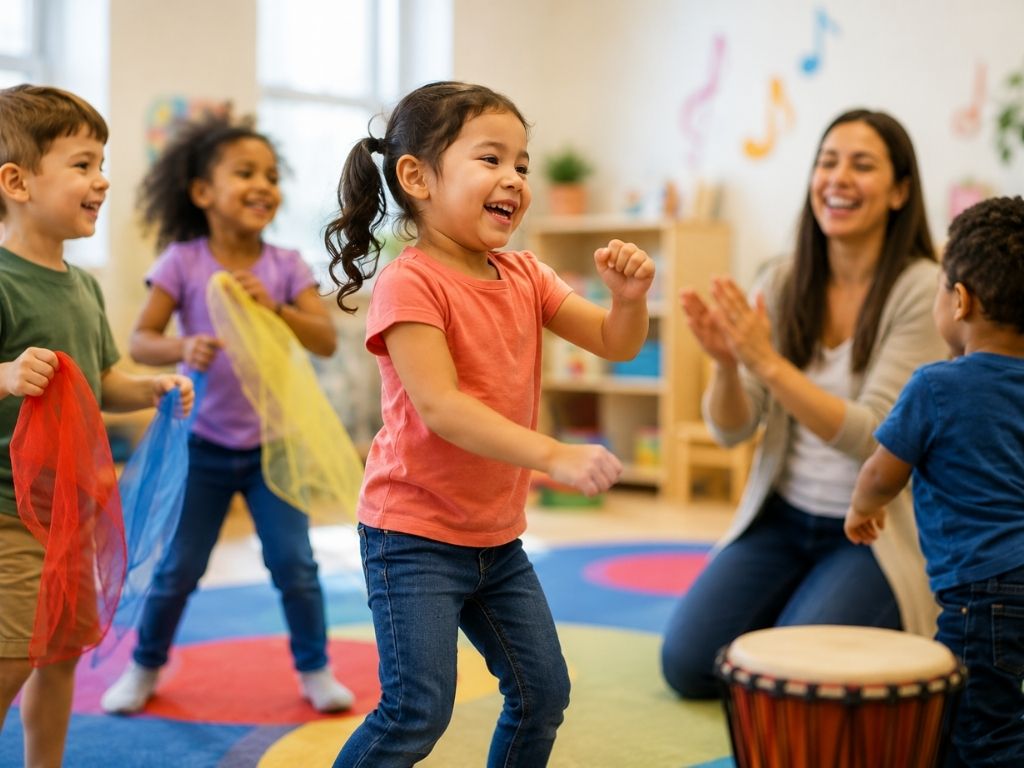
When preschoolers clap to a beat, march around a classroom, or suddenly freeze when the music stops, it may look like simple fun. Behind those playful actions, however, children are listening, remembering instructions, coordinating their bodies, and deciding how and when to respond.
That is what makes music and movement for preschool so valuable. Singing and moving can bring several developing skills together in one engaging activity, giving children opportunities to practice attention, language, memory, coordination, and self-control.
What Happens in the Brain When Preschoolers Hear Music?
Listening to a song involves much more than hearing sound. Children notice changes in pitch, follow rhythms, recognize familiar melodies, anticipate repeated patterns, and process the words being sung.
Young brains are also highly adaptable. Through neuroplasticity, the brain changes as children gain experiences and repeatedly practice skills.
Research from the Rotman Research Institute and York University provides an interesting glimpse into this process. In a study of 36 children ages four to six, researchers found measurable changes in brain responses following short-term music or second-language training. Some training-related brain changes were still detectable one year later.
While this does not mean every preschool song produces lasting brain changes, the findings demonstrate how responsive the developing brain can be to repeated learning experiences.
Changing the Experience with Movement
Preschoolers rarely just sit and listen to music. They clap, jump, sway, point, stomp, spin, and imitate actions.
Adding movement asks children to connect what they hear with what their bodies do. Consider a simple freeze-dance game. A child has to listen to the music, keep moving, notice when the sound stops, remember the rules, and stop their body at the appropriate moment.
Action songs can similarly ask children to remember sequences and coordinate movements with words. This combination makes music and movement for preschool an opportunity to practice several skills simultaneously.
Music, Movement and Development
Music and movement can support a child’s development by providing playful opportunities to practice attention, working memory, self-control, coordination, language, and social participation.
These activities can be particularly useful for practicing executive functions or the mental skills children use to remember information, control impulses, shift between tasks, and stay focused.
Different games can challenge these abilities in different ways. Freeze games require children to stop an action on cue. Repeating a clapping pattern uses working memory. Switching from marching to hopping when the music changes encourages cognitive flexibility.
A 2025 systematic review and meta-analysis of 10 studies involving children ages three to six found that music training was associated with significant improvements in inhibitory control, working memory, and cognitive flexibility compared with control conditions. The reported standardized mean differences were 0.38, 0.35, and 0.23, respectively.
Singing Gives Children a Workout With Words
Songs also create natural opportunities to explore language.
Preschool songs frequently contain rhymes, repeated vocabulary, predictable phrases, and noticeable rhythms. As children hear a familiar song repeatedly, they may begin anticipating the next word or joining in without prompting.
Adding gestures can provide another cue. A song about body parts, for example, lets children hear a word while physically identifying what it represents. Counting songs can similarly pair numbers with actions.
This does not mean singing automatically accelerates language development. Instead, songs offer an engaging format for repeated exposure to words, sounds, rhymes, and sentence patterns.
Rhythm Encourages Children to Listen, Predict, and Respond
Rhythm is another reason music and movement for preschool can be so engaging. Imagine a teacher clapping “clap-clap-pause-clap” and asking children to repeat it. Children must pay attention to the pattern, remember its order, anticipate the timing, and reproduce it.
These experiences do not require complicated instruments. Educators and families can try:
- Copy-the-clap games
- Marching to fast and slow beats
- Tapping simple rhythms
- Stopping when music stops
- Repeating patterns with safe rhythm instruments
Adults can gradually make patterns more challenging as children become familiar with the activity.
Music and Movement Can Be Social, Too
When music happens in a group, children also have to notice what other people are doing.
Group activities can provide opportunities to practice waiting, taking turns, imitating others, following shared cues, and moving together. Predictable songs can also support classroom routines.
A welcome song can signal the beginning of the day, while cleanup and transition songs can help children recognize what comes next. In this way, music and movement for preschool can become part of the rhythm of everyday classroom life.
Simple Music and Movement Activities to Try
Effective activities do not require elaborate choreography or expensive equipment. Preschoolers can learn through simple, playful experiences. Remember that the goal is participation and exploration, not perfect musical performance.
- Freeze Dance: Dance while music plays and stop when it pauses to practice listening and inhibitory control.
- Copy My Rhythm: Clap or tap a pattern for children to reproduce, encouraging attention and working memory.
- Animal Movements: Pair music with hopping like a rabbit, stomping like an elephant, or waddling like a duck.
- Fast and Slow: Change the tempo and have children adjust their movements accordingly.
- Action-Song Memory: Add movements one at a time and challenge children to remember the growing sequence.
Learning That Looks Like Play
When children sing, dance, clap, and laugh, they may also be remembering patterns, processing language, controlling movements, listening for cues, and responding to other people.
That is the strength of music and movement for preschool: several developing abilities can be practiced together through an activity children naturally enjoy.
At Outer Limits School, engaging activities such as music and movement are incorporated into early learning experiences that encourage children to explore, participate, and develop important skills. Contact Outer Limits School today to learn more about its preschool programs and how they support children’s growth through active learning.