
You’re not just choosing a preschool. You’re choosing how your child learns to think, solve problems, and handle independence.
The Montessori method sounds appealing, but most parents hesitate for one reason: it’s different. Not “better” by default. Not “worse.” Just different.
So the real question is not what is Montessori? It’s this: Will this environment actually work for your child?
Let’s break that down with specifics.
What Is the Montessori Method?
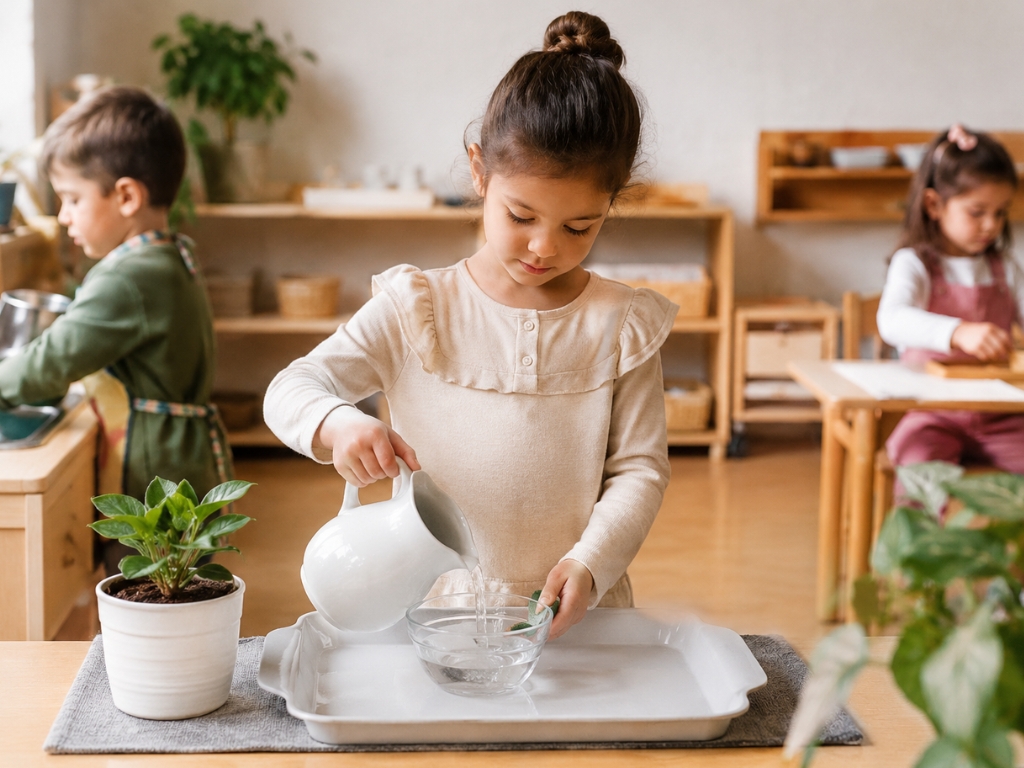
The Montessori method is a child-centered approach to education that encourages children to learn through hands-on activities, independent exploration, and self-paced development. Instead of one teacher leading the whole class in the same lesson, children choose from guided activities designed to match their age, interests, and readiness.
In a Montessori classroom, learning focuses on building independence, concentration, confidence, and practical life skills.
What are the 5 Principles of Montessori?
The five principles behind Montessori help parents look past the label and understand what their child will actually experience in the classroom.
1 | Respect for the Child
Respect for the child means seeing children as capable learners. In a Montessori classroom, teachers give children room to try, repeat, make mistakes, and improve without stepping in too quickly, which helps build confidence and concentration over time.
2 | The Absorbent Mind
The absorbent mind refers to the way young children naturally take in information from everything around them. That is why Montessori classrooms are carefully designed, because children learn not only from lessons, but also from the order, tone, and structure of their environment.
3 | Sensitive Periods
Sensitive periods are stages when children are especially ready to learn certain skills, such as language, movement, or order. Montessori follows these moments of readiness instead of forcing development, which often leads to deeper learning and less frustration.
4 | Prepared Environment
A prepared environment is a classroom arranged to help children act independently. Materials are organized, accessible, and purposeful, so children can move through the space with confidence and learn to do more on their own.
5 | Auto-Education
Auto-education means children are able to guide much of their own learning when the environment and support are right. Rather than relying on constant correction, they learn by exploring, noticing mistakes, and trying again, which strengthens independence and resilience.
Key Factors to Consider
Before deciding if the Montessori method is the right fit, it helps to look beyond the philosophy and focus on how it will affect your child’s daily experience.
Every child responds differently to structure, independence, and learning styles. These factors will help you evaluate whether this environment aligns with both your child’s needs and your expectations as a parent.
1 | Your Child’s Comfort With Independence
The Montessori method encourages children to make choices, complete tasks, and solve small challenges on their own. This can build confidence over time, but it also requires a certain level of readiness.
If your child already shows curiosity and enjoys figuring things out independently, they may adapt quickly. If they rely more on direction, expect a transition period as they adjust to having more responsibility.
2 | Your Expectations Around Structure
Montessori classrooms follow a routine, but they are not rigid or teacher-led in the traditional sense. Instead of group-based instruction, children move through activities at their own pace within a structured environment.
For some parents, this feels more natural and supportive. For others, it may feel less predictable. Understanding this difference helps set realistic expectations.
3 | How Your Child Learns Best
Learning in a Montessori setting is hands-on and experience-based. Children use physical materials, repeat tasks, and learn by doing rather than listening.
If your child tends to engage more when they can touch, move, and explore, this approach can support deeper understanding. If they prefer direct instruction, the adjustment may take time.
4 | The Importance of School and Home Alignment
Consistency between school and home plays a bigger role than many parents expect. In Montessori classrooms, children are encouraged to make choices and take responsibility for simple tasks.
When similar expectations are supported at home, children often feel more confident and settled. Without that alignment, progress may feel slower or less consistent.
5 | Your Long-Term Goals for Early Education
Think about what matters most to you beyond early academics. The Montessori method focuses on building independence, concentration, and problem-solving skills over time.
If your goal is to help your child become more self-directed and confident in their learning, this approach may align well with your expectations.
Common Concerns Parents Have
Even when the Montessori philosophy makes sense, parents often still have a few practical concerns before making a decision. These questions are valid, especially when you are trying to choose the best learning environment for your child.
Common concerns include:
- Will my child adjust well to a traditional school later on?
Many parents worry that the Montessori method may feel too different from a standard classroom. In reality, children from Montessori environments often transition well because they have already built focus, adaptability, and confidence in their ability to learn. - Does a Montessori classroom have enough structure?
Montessori classrooms do have structure, but it looks different from a traditional teacher-led setting. Instead of being imposed through constant direction, structure is built into the classroom routine, the organization of materials, and the expectations children learn to follow each day. - Will my child get enough social interaction?
Social development is a common concern, especially for parents who are unfamiliar with mixed-age classrooms. Montessori students typically have daily opportunities to communicate, collaborate, and learn from one another, which can support strong social and communication skills over time.
Final Thoughts
The Montessori method can be a strong fit for families who want more than a traditional preschool experience. It supports independence, hands-on learning, concentration, and confidence, while giving children the space to grow at their own pace. At the same time, it is important to consider how your child responds to freedom, structure, and self-directed learning before making a decision.
If you are exploring preschool options, the best next step is to see the environment for yourself. Contact Quality Interactive Montessori Preschool to learn more about the Montessori method, ask questions, and schedule a visit to find out if it is the right fit for your child.